
Large-Format Porcelain Slabs: Sizes, Benefits, and Applications
Modern architecture is increasingly embracing expansive surfaces, clean lines and minimal visual interruptions. Whether in residential interiors, luxury hotels or commercial spaces, the choice of surface material plays an important role in creating the desired appearance.
Large-format porcelain slabs have become a popular option for these projects because they combine contemporary design possibilities with practical performance.
Available in a variety of sizes, thicknesses, colours and finishes, porcelain slabs can be used across walls, floors, kitchen countertops and decorative surfaces, provided the selected product is suitable for the intended application.
But what exactly are large-format porcelain slabs? What sizes are available, and how do you choose the right one?
This guide explores the benefits, popular dimensions, applications and key considerations for architects, designers, distributors and international buyers.
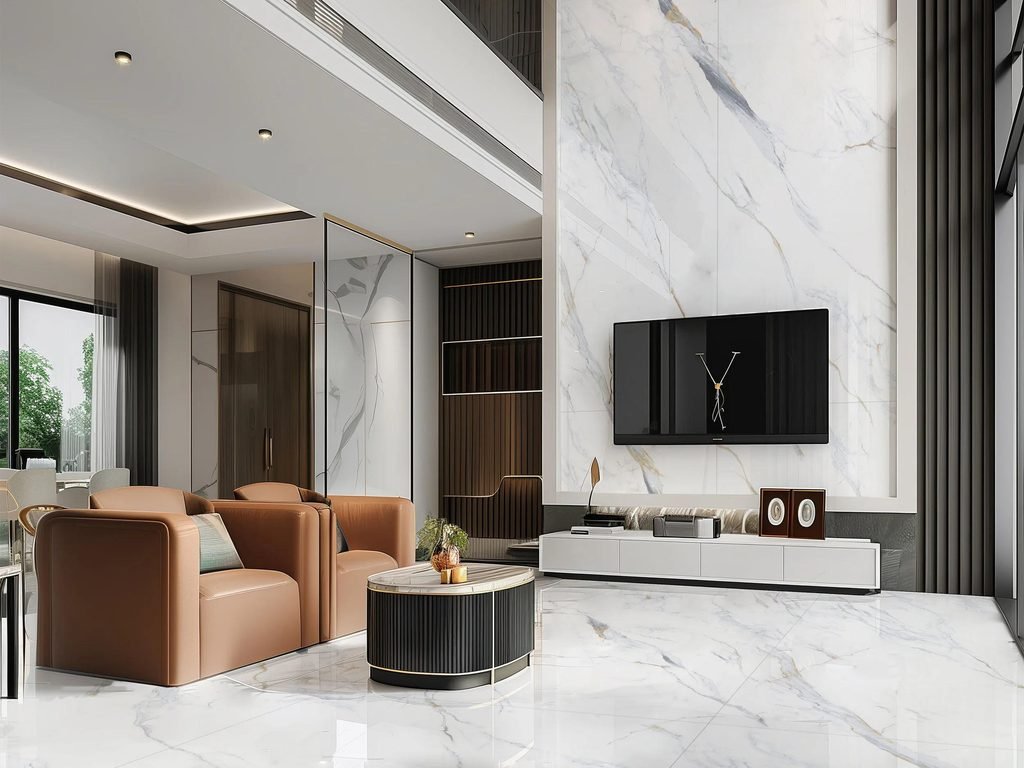
Insert Image 1 – Large-format porcelain slab in a modern interior.
What Are Large-Format Porcelain Slabs?
Large-format porcelain slabs are oversized ceramic panels manufactured using mineral-based raw materials that are compacted and fired at high temperatures.
Unlike traditional smaller tiles, these slabs cover a larger surface area with fewer individual pieces.
Their dimensions make them suitable for creating extensive wall surfaces, statement kitchen islands and architectural features.
Porcelain slabs are available in different appearances, including:
- Marble-look surfaces
- Natural stone-inspired patterns
- Concrete-look designs
- Solid and neutral colours
- Polished and matte finishes
- Decorative architectural patterns
Their low water absorption, surface hardness and design versatility make them a practical choice for many interior applications.
Explore the Vishwas Export product collections to discover available surface options.
Popular Large-Format Porcelain Slab Sizes
Choosing the appropriate slab size is an important step in planning any architectural project.
The ideal dimensions depend on the installation area, design requirements, fabrication needs and available handling equipment.
Vishwas Export’s website provides packaging specifications for several porcelain slab formats.
Common porcelain slab dimensions
| Slab size | Nominal surface area | Potential applications |
|---|---|---|
| 800 × 2400 MM | 1.92 SQM | Feature walls, decorative panels |
| 1200 × 2400 MM | 2.88 SQM | Wall cladding, architectural surfaces |
| 1200 × 2800 MM | 3.36 SQM | Full-height wall installations |
| 1200 × 3200 MM | 3.84 SQM | Large wall panels, suitable for fabricated surfaces |
| 1600 × 3200 MM | 5.12 SQM | Statement walls, large kitchen islands |
These formats appear in the company’s packaging information. Their suggested applications are general examples, not confirmation that every design and thickness is suitable for each use.
Why does slab size matter?
Larger slabs can influence both the visual appearance and installation process.
Fewer visible joints: A larger slab may cover more surface area without additional seams.
Continuous patterns: Large marble-look and stone-look designs can create an impressive visual effect.
Design flexibility: Architects can use the dimensions to plan full-height walls and expansive surfaces.
Fabrication planning: Accurate dimensions help reduce unnecessary cutting and material wastage.
However, larger slabs require careful transportation, specialised handling and appropriate installation methods.
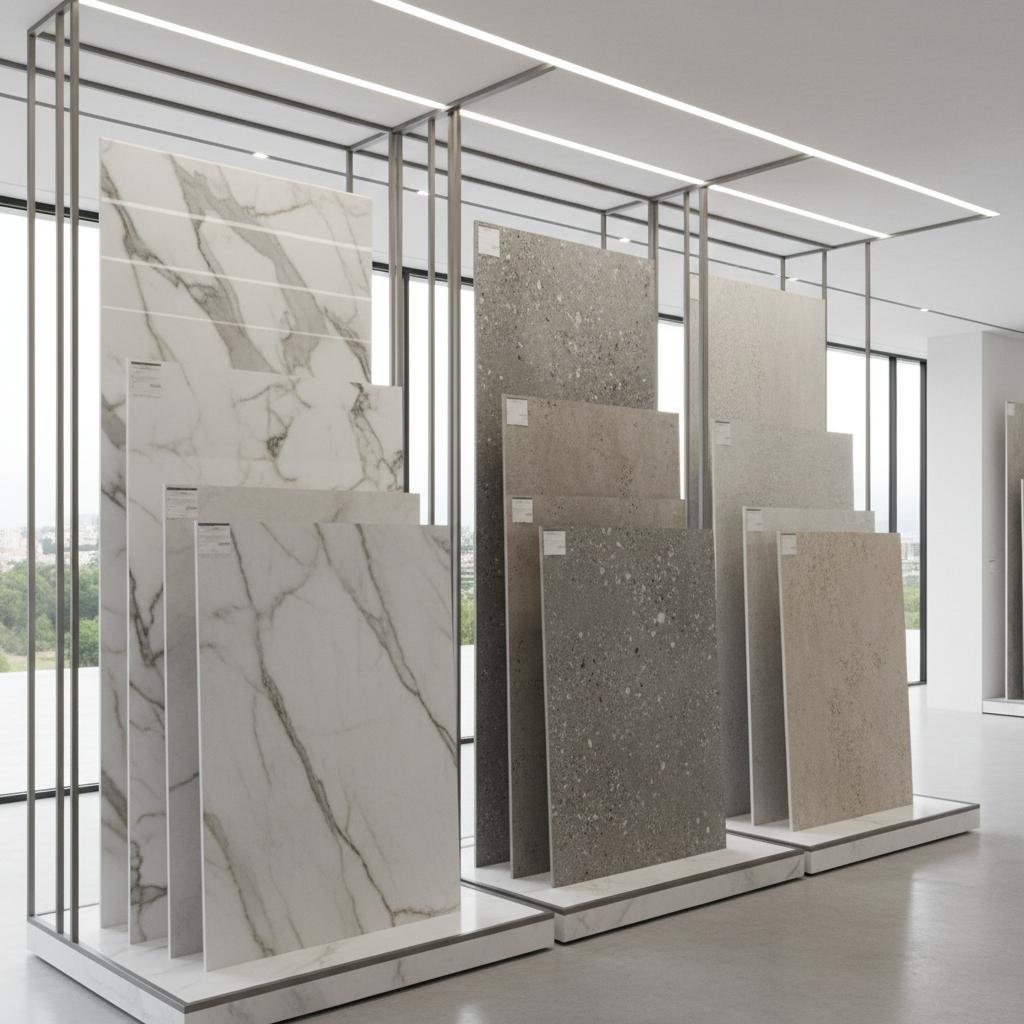
Insert Image 2 – Display of porcelain slabs in different dimensions.
Understanding Porcelain Slab Thickness
Thickness is just as important as slab size.
A slab’s thickness can affect its weight, handling requirements, fabrication process and suitability for particular applications.
Vishwas Export’s packaging specifications list slab thickness options including:
- 6 MM
- 9 MM
- 12 MM
- 15 MM
Not every size is listed in every thickness.
6 MM porcelain slabs
Thin porcelain slabs can be useful for selected wall-cladding and decorative applications when used with a suitable installation system.
Because of their relatively low thickness, specialised handling and proper substrate preparation are especially important.
9 MM porcelain slabs
Depending on their technical specifications, these slabs may be considered for selected wall, floor and architectural applications.
The suitability of each product should be confirmed before installation.
12 MM porcelain slabs
This thickness can be used in various architectural applications, subject to the slab’s technical properties and fabrication requirements.
For countertops and furniture, appropriate support and manufacturer approval are essential.
15 MM porcelain countertop slabs
Vishwas Export’s packaging page specifically identifies several 15 MM countertop slab formats.
These include 800 × 2400 MM, 1200 × 2800 MM and 1600 × 3200 MM.
For buyers planning countertop fabrication, it is important to confirm the product’s intended use, edge detail, support requirements and installation recommendations.
You can review the listed sizes and thicknesses on the Vishwas Export Packaging Details page.
6 Benefits of Large-Format Porcelain Slabs
1. Minimal grout lines
One of the most noticeable advantages of large-format porcelain slabs is their ability to cover expansive surfaces with fewer joints.
This creates a cleaner and more continuous appearance compared with installations using many smaller tiles.
However, appropriate joints and movement provisions are still required.
2. Wide variety of designs
Porcelain slabs can reproduce the appearance of marble, natural stone, concrete and other materials.
This gives architects and interior designers considerable flexibility in creating different visual styles.
3. Low water absorption
Porcelain generally has very low water absorption.
This property makes appropriately specified porcelain surfaces suitable for many areas where moisture resistance is important.
However, waterproofing and installation requirements must still be addressed separately.
4. Resistance to everyday staining
Many porcelain surfaces offer good resistance to common stains, depending on the product and finish.
Spills should still be cleaned promptly using suitable cleaning products.
5. Versatile applications
Large-format slabs can be used in numerous architectural settings.
From decorative walls to suitably fabricated countertops, they offer possibilities beyond conventional flooring.
6. Relatively straightforward maintenance
Porcelain surfaces generally require routine cleaning rather than the specialised sealing procedures associated with some natural stones.
Always follow the manufacturer’s cleaning recommendations for the specific finish.
Applications of Large-Format Porcelain Slabs
Large-format porcelain slabs offer several design possibilities for residential and commercial projects.
Kitchen countertops and islands
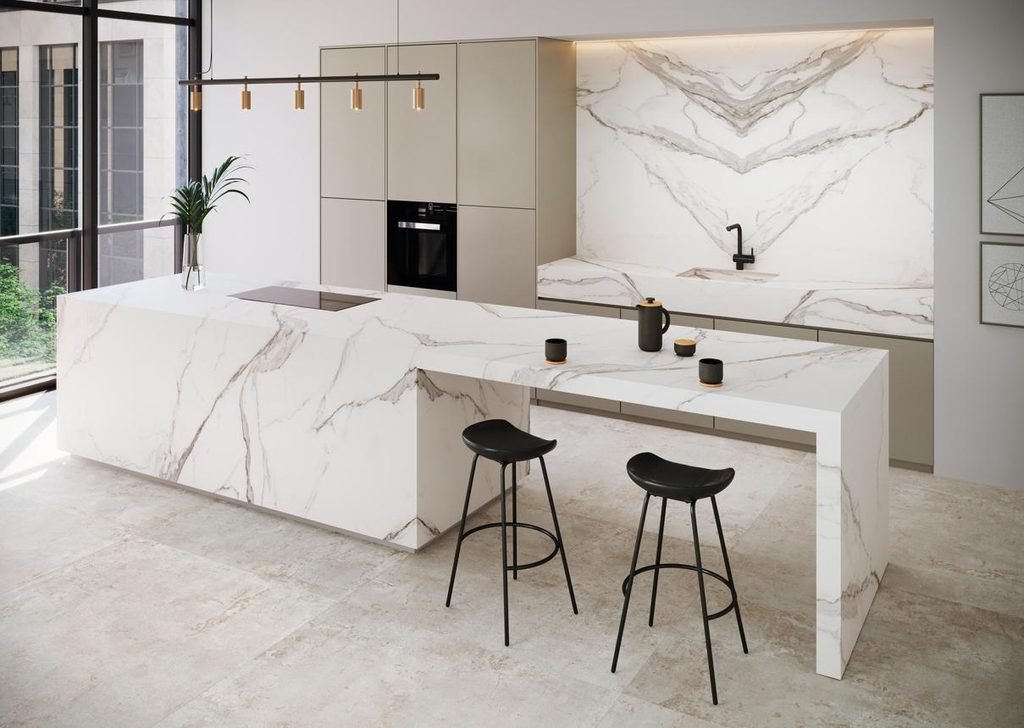
One of the most visually appealing applications is the modern kitchen island.
Suitable porcelain slabs can be fabricated into broad work surfaces and waterfall-style countertops.
Marble-look porcelain is particularly popular for creating a refined appearance.
However, kitchen countertop fabrication requires an approved slab thickness, appropriate support and professional installation.
Insert Image 3 – Porcelain slab kitchen island.
Living room feature walls
Large slabs can create striking feature walls with uninterrupted patterns.
They may be installed behind television units, seating areas or other architectural focal points.
Natural stone-inspired finishes are often used to create a sophisticated atmosphere.
Bathroom walls
Large-format porcelain slabs can be used to create expansive bathroom wall surfaces with fewer grout lines.
Light-coloured marble-look designs can help create a bright, contemporary appearance.
Correct waterproofing, support and installation systems are essential.
Commercial interiors
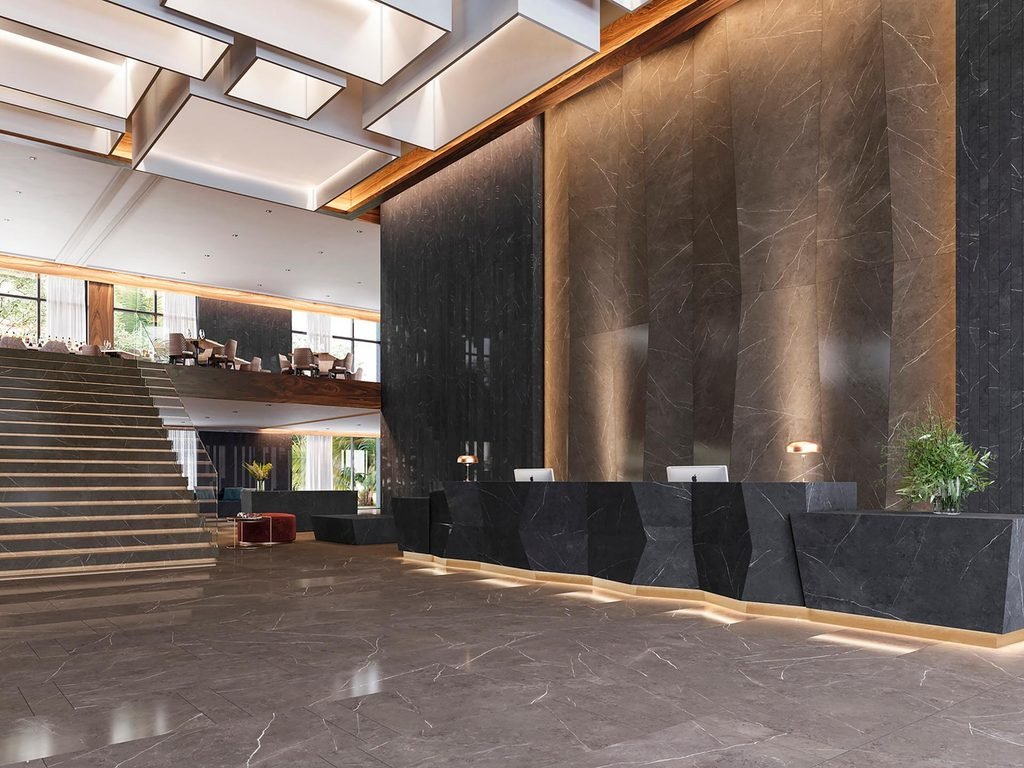
Porcelain slabs may be suitable for selected hotel lobbies, reception areas, office interiors and retail spaces.
Their large size allows designers to create visually consistent wall surfaces.
Insert Image 4 – Porcelain slabs in a commercial interior.
Furniture and decorative surfaces
Suitable porcelain slabs can also be used for tabletops, furniture panels and decorative architectural elements.
The correct thickness, edge treatment, fabrication and structural support must be considered for each application.
Large-Format Porcelain Slabs vs Traditional Tiles
Both large-format slabs and conventional tiles offer advantages.
The best choice depends on project requirements, budget and installation conditions.
| Feature | Large-format porcelain slabs | Traditional porcelain tiles |
|---|---|---|
| Dimensions | Oversized panels | Generally smaller formats |
| Grout lines | Fewer across the same area | Usually more |
| Visual effect | Expansive, continuous appearance | Greater flexibility in smaller layouts |
| Handling | Specialised handling often required | Generally easier to handle individually |
| Installation | Requires appropriate expertise and equipment | Depends on size and application |
| Applications | Feature walls, selected countertops and architectural surfaces | Flooring, walls and other suitable applications |
Large-format porcelain slabs are especially attractive when the desired design emphasises continuous surfaces and large decorative patterns.
How to Choose the Right Porcelain Slabs
Selecting a slab involves more than choosing its dimensions and appearance.
1. Identify the application
Determine whether the slab will be used on a wall, floor, countertop or decorative structure.
Every application has different performance and installation requirements.
2. Select the appropriate size
Choose dimensions that suit the project layout and minimise unnecessary seams or cutting.
Remember to account for transport access, doorways, lifts and installation space.
3. Confirm thickness
Slab thickness should match the intended application and the manufacturer’s technical recommendations.
Never assume that all large-format slabs are suitable for countertops or flooring.
4. Evaluate design and finish
Compare polished, matte and other available surface finishes.
For flooring, verify the required slip-resistance performance rather than relying on appearance alone.
5. Request technical specifications
International buyers should request relevant information such as:
- Slab dimensions and tolerances
- Thickness
- Water absorption
- Breaking strength
- Surface finish
- Application suitability
- Appropriate test reports
6. Consider packaging and logistics
Large slabs require suitable protection during handling and transport.
Confirm packing arrangements, container requirements and loading specifications before finalising an international order.
How Are Large-Format Porcelain Slabs Packed for Export?
Export packaging is particularly important for large-format porcelain slabs because of their dimensions, weight and susceptibility to damage during handling.
Different slab sizes may require different transport arrangements.
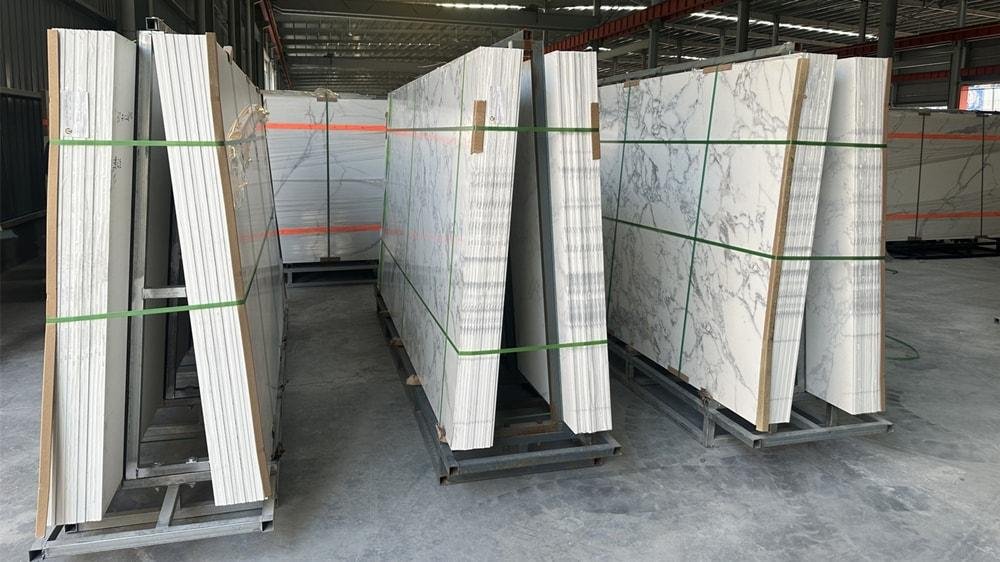
Vishwas Export’s packaging specifications identify both A-frame and U-frame iron support systems for different porcelain slab formats.
The page also provides indicative container arrangements for certain products.
Insert Image 5 – Large-format porcelain slabs secured in transport frames.
For international buyers, important considerations include:
- Suitable support frames and protective materials
- Appropriate handling and lifting methods
- Container loading and weight distribution
- Product dimensions and shipment quantities
- Packing lists and relevant shipping documentation
Specific loading quantities should always be confirmed for the actual order.
For more information, visit Vishwas Export’s Packaging Details.
Why Transparency Matters When Sourcing Porcelain Slabs
For international importers, wholesalers and distributors, product selection is only one part of the purchasing process.
Clear communication about specifications, packaging and shipment requirements is essential for making informed decisions.
Before confirming a large-format porcelain slab order, buyers should understand:
- Which slab sizes are available
- What thicknesses are offered
- Which finishes and designs can be supplied
- Whether the slab is suitable for the intended application
- How the slabs will be packaged
- What product documentation is available
This approach reflects the importance of Trust with Transparency – Vishwas Export’s commitment to building confidence through clear product information and communication.
Buyers can learn more about Vishwas Export and explore its surface offerings.
Frequently Asked Questions
What is the largest porcelain slab size?
Porcelain slab dimensions vary by manufacturer. Vishwas Export’s packaging information includes a 1600 × 3200 MM format, although available sizes and thicknesses should be confirmed for each product.
Are large-format porcelain slabs durable?
Appropriately specified porcelain slabs can offer good durability. Their performance depends on product characteristics, fabrication, installation and intended use.
Can porcelain slabs be used for kitchen countertops?
Yes. Certain porcelain slabs are manufactured for countertop applications. Vishwas Export lists countertop slab formats in its packaging information, but product suitability must be confirmed before fabrication.
Are porcelain slabs better than marble?
Neither material is universally better. Porcelain offers manufactured designs and low water absorption, while natural marble provides unique geological patterns. The ideal choice depends on design preferences and application requirements.
Do large-format porcelain slabs require special installation?
Yes. Their dimensions often require specialised handling equipment, suitable installation materials and experienced installers.
Where can I find large-format porcelain slabs in India?
Morbi, Gujarat, is an important centre for ceramic and porcelain products. Buyers can explore the Vishwas Export collection and contact the company for relevant product information.
Conclusion
Large-format porcelain slabs offer an attractive combination of design flexibility, low water absorption and a contemporary appearance.
From expansive feature walls to suitably fabricated countertops and commercial architectural surfaces, they provide opportunities to create sophisticated spaces.
However, choosing the right porcelain slab requires careful consideration of size, thickness, finish, technical performance and installation requirements.
For international buyers, transparent product specifications and clearly communicated packaging arrangements are equally important.
Explore Large-Format Porcelain Slabs with Vishwas Export
Looking for porcelain slabs for your next architectural project or bulk sourcing requirement?
Discover available surface options and discuss your specifications with Vishwas Export.