Granite Slabs: Complete Guide to Sizes, Thickness, Finishes and Applications
Natural stone has long been valued for its strength, distinctive appearance and versatility in architecture. Among the various options available, granite slabs remain a popular choice for residential, commercial and architectural projects.
From elegant kitchen countertops to durable flooring and wall cladding, granite offers both visual appeal and practical performance.
However, choosing the right granite slab involves more than selecting an attractive colour. Understanding slab dimensions, thickness, finishes and intended applications is essential for making the right decision.
Whether you are an architect, interior designer, construction professional, stone distributor or international buyer, this guide will help you understand the key factors involved in selecting granite slabs.
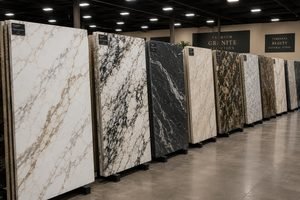
Insert Image 1 – Natural granite slab collection.
What Are Granite Slabs?
Granite slabs are large, flat pieces of natural stone cut from granite blocks extracted from quarries.
Granite is an igneous rock that forms through the gradual cooling and crystallisation of molten material beneath the Earth’s surface. Its mineral composition gives it distinctive colours, grains and patterns.
After extraction, granite blocks are cut into slabs and processed to achieve the required dimensions, thickness and surface finish.
The resulting slabs can be used for numerous architectural applications.
Unlike manufactured surfaces, natural granite slabs have unique variations in colour and pattern. These natural characteristics make each slab visually distinctive.
Some of the most common applications include:
- Kitchen countertops and islands
- Bathroom vanity tops
- Flooring and staircases
- Interior and exterior wall cladding
- Commercial reception counters
- Tables and decorative surfaces
- Selected outdoor architectural applications
Buyers can explore the Vishwas Export product collection to discover available stone and surface designs.
Standard Granite Slab Sizes
Granite slabs are available in different dimensions depending on the quarry, granite variety and processing facility.
Unlike manufactured tiles, natural stone slabs do not always follow one fixed dimensional standard.
Understanding available slab sizes helps buyers reduce material waste, estimate project requirements and plan fabrication.
Common granite slab dimensions
The following measurements are illustrative industry ranges, not confirmed Vishwas Export stock specifications.
| Granite slab category | Approximate dimensions |
|---|---|
| Small slabs | 1800 × 600 mm and above |
| Standard slabs | 2400 × 1200 mm |
| Large slabs | 2800 × 1600 mm |
| Extra-large slabs | 3000 × 1800 mm and above |
Actual dimensions vary significantly between stone varieties and suppliers.
Buyers should always request the available slab dimensions before placing an order.
Why granite slab size matters
Selecting an appropriate slab size offers several practical advantages.
Reduced material wastage: Larger slabs can allow fabricators to cut surfaces more efficiently, depending on the project layout.
Fewer visible joints: Kitchen islands and large countertops may benefit from slabs that can cover the required surface with fewer seams.
Design consistency: Larger slabs may help preserve continuous natural stone patterns across a surface.
Improved project planning: Accurate measurements make it easier to estimate material quantities and fabrication requirements.
For commercial and bulk projects, slab dimensions should be confirmed during the material selection process.
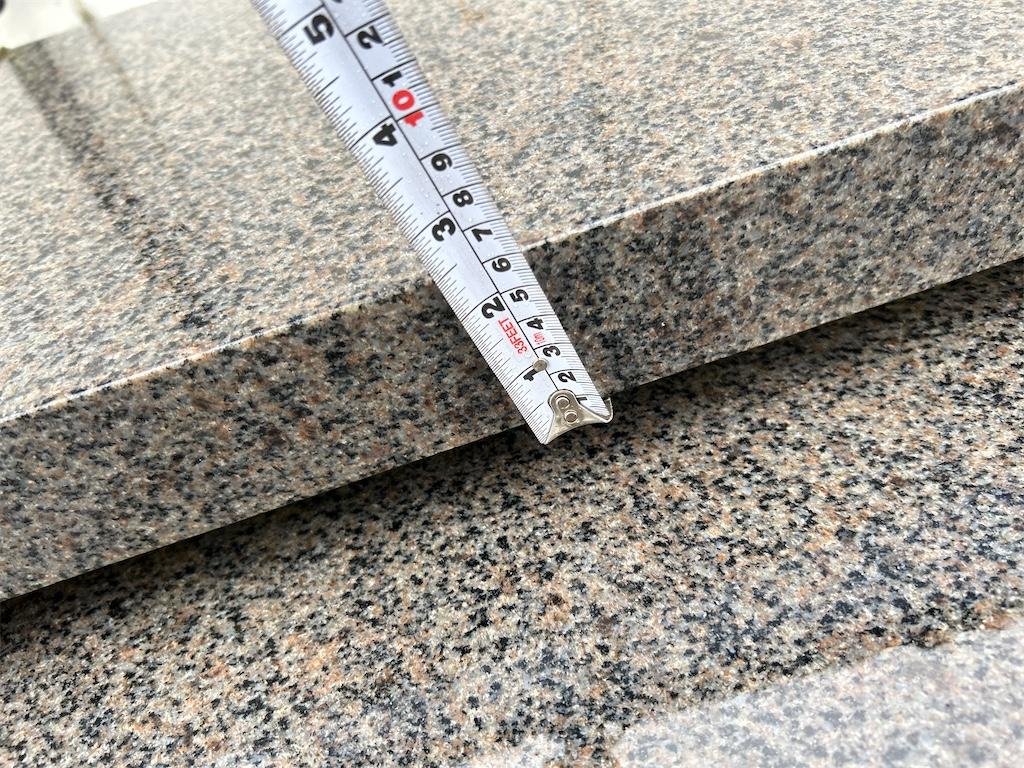
Insert Image 2 – Granite slab thickness and edge details.
Granite Slab Thickness: 20 mm vs 30 mm
Thickness is another important factor when selecting granite slabs.
Two commonly used thickness options for countertops and architectural applications are 20 mm and 30 mm.
However, other thicknesses are available, and the correct specification depends on the project design, fabrication method and structural requirements.
20 mm granite slabs
Granite slabs measuring approximately 20 mm thick are frequently used for applications where a slimmer profile is preferred.
Potential applications include:
- Bathroom vanity tops
- Interior wall cladding
- Selected countertops with suitable support
- Decorative architectural surfaces
Thinner slabs are generally lighter than thicker slabs of the same dimensions and stone density.
However, correct handling, fabrication and support are essential.
30 mm granite slabs
Granite slabs measuring approximately 30 mm thick are commonly chosen for kitchen countertops and other applications requiring a more substantial appearance.
They may offer greater rigidity than thinner slabs of the same stone, although the installation must still be properly designed.
Common applications include:
- Kitchen countertops
- Large kitchen islands
- Commercial counter surfaces
- Premium architectural installations
Which granite thickness should you choose?
The choice between 20 mm and 30 mm granite depends on the application.
| Feature | 20 mm granite | 30 mm granite |
|---|---|---|
| Appearance | Slim profile | Thicker appearance |
| Weight | Lower | Higher |
| Material volume | Lower | Higher |
| Support needs | May require additional reinforcement | Still requires appropriate structural support |
| Typical applications | Vanities, cladding, selected countertops | Countertops, islands, counters |
The final thickness should be approved by a qualified fabricator or project professional, especially for large spans, cut-outs and overhangs.
Popular Granite Slab Finishes
The surface finish affects the appearance, texture and maintenance requirements of granite slabs.
Different finishes can create completely different visual effects from the same natural stone.
Insert Image 3 – Comparison of granite finishes.
1. Polished granite slabs
Polished granite has a glossy and reflective appearance that enhances the natural colours and mineral patterns of the stone.
Common applications:
- Kitchen countertops
- Bathroom vanities
- Interior decorative surfaces
- Commercial reception counters
A polished finish is often preferred for projects seeking a refined appearance.
2. Honed granite slabs
Honed granite has a smooth surface with a matte or low-sheen appearance.
It creates a more subtle visual effect than polished granite.
Common applications:
- Contemporary interior surfaces
- Decorative walls
- Selected floors
- Bathroom surfaces
Honed granite may require particular attention to staining and maintenance depending on the stone variety.
3. Leathered granite slabs
Leathered granite features a textured surface that highlights the stone’s natural characteristics.
It is frequently selected for projects that require a distinctive tactile appearance.
Common applications:
- Kitchen countertops
- Statement islands
- Decorative furniture
- Architectural features
4. Flamed granite slabs
Flamed granite is processed using high temperatures to create a rougher, textured surface.
This treatment is suitable only for certain granite varieties.
Common applications:
- Outdoor paving
- External staircases
- Selected commercial exterior areas
For walking surfaces, the required slip resistance should be confirmed through appropriate product testing rather than assumed from the finish alone.
Applications of Granite Slabs in Modern Architecture
Granite is used across residential and commercial projects because of its natural appearance and performance characteristics.
Kitchen countertops
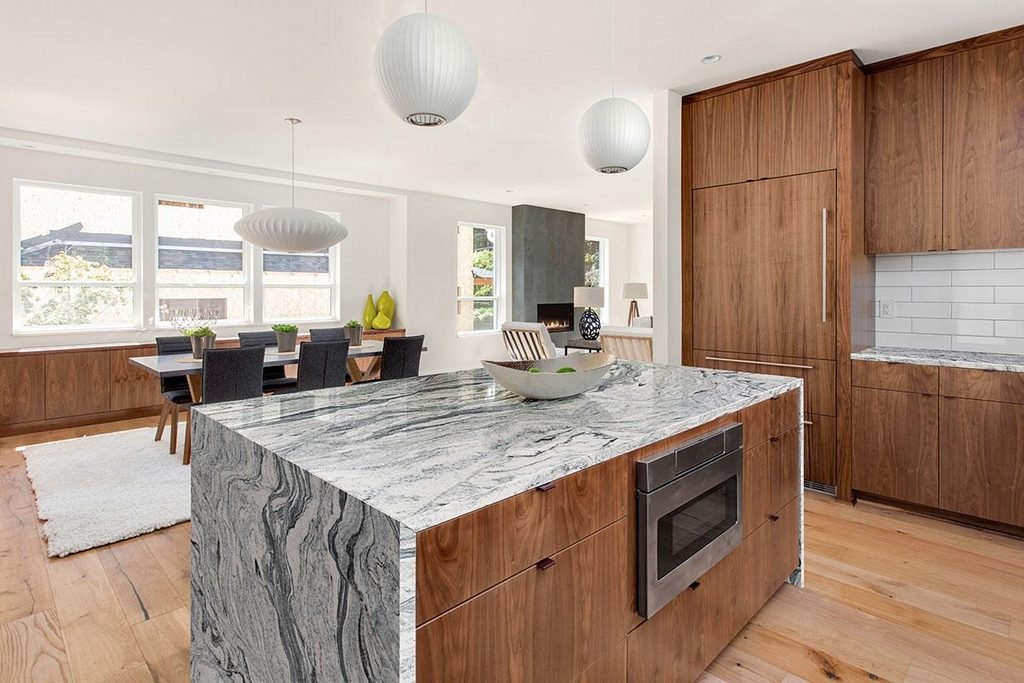
One of the most recognisable applications of granite is kitchen countertop fabrication.
Granite offers a durable working surface with a variety of natural colours and patterns.
Its appearance can complement modern, traditional and minimalist kitchen interiors.
For additional information, read our guide: Granite Countertops: Benefits, Types and How to Choose the Right Stone.
Insert Image 4 – Kitchen featuring a natural granite slab countertop.
Flooring
Granite can be used for residential and commercial flooring where the selected product meets the relevant performance requirements.
Its wear resistance makes it suitable for many high-traffic environments.
However, finish selection, slip resistance and installation quality must be considered carefully.
Wall cladding
Granite slabs are used for decorative interior walls and selected exterior façades.
Their natural patterns create distinctive architectural surfaces.
For exterior applications, the fixing system, wind loads, stone properties and local building requirements must be assessed.
Bathroom vanities
Granite can create elegant vanity countertops and decorative bathroom surfaces.
Appropriate sealing, cleaning and fabrication help maintain the stone’s appearance.
Commercial interiors
Granite is also used for reception counters, hotel interiors, retail spaces, tables and decorative features.
These applications benefit from granite’s combination of durability and appearance.
How to Choose High-Quality Granite Slabs
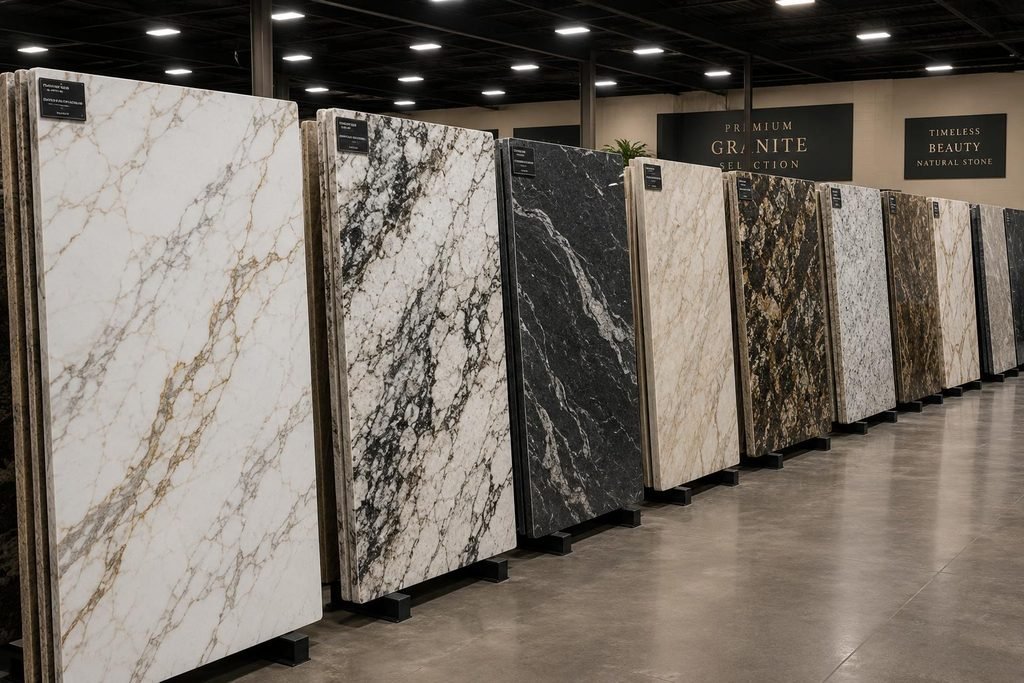
Selecting quality granite requires a structured evaluation process.
1. Inspect the stone surface
Look for unwanted cracks, chips, repairs, significant surface defects and any irregularities that may affect fabrication.
Natural colour variations and mineral markings are not necessarily defects, but they should be understood before purchase.
2. Confirm slab dimensions
Request the exact length, width and thickness of the available slabs.
This information is especially important for kitchen islands, large-format installations and commercial projects.
3. Check colour and pattern consistency
Natural granite varies between individual slabs and production batches.
For projects requiring multiple matching pieces, request photographs or inspect the actual slabs whenever possible.
4. Verify the surface finish
Confirm whether the required polished, honed, leathered or other finish is available for the chosen stone.
Finish consistency should be evaluated before bulk orders are finalised.
5. Evaluate the supplier
Buyers should assess product documentation, quality control, communication and order-handling procedures.
International buyers should also confirm packaging methods, shipping arrangements and relevant export documentation.
For more information about the company, visit About Vishwas Export.
Granite Slabs vs Engineered Stone Slabs
Natural granite and engineered stone are both used in architectural applications, but they differ in composition and appearance.
| Feature | Natural granite slabs | Engineered stone slabs |
|---|---|---|
| Material | Natural geological stone | Manufactured composite or engineered material |
| Patterns | Natural variations | Designed or controlled patterns |
| Heat resistance | Generally good, with precautions | Depends on composition and manufacturer |
| Maintenance | Varies by stone and finish | Varies by material |
| Appearance | Unique natural characteristics | Often more consistent designs |
The right choice depends on project requirements, budget, performance specifications and design preferences.
Buyers should review product-specific technical documentation before making a final decision.
Granite Slab Packaging and Export Considerations
For international buyers, selecting the right stone is only one part of the purchasing process.
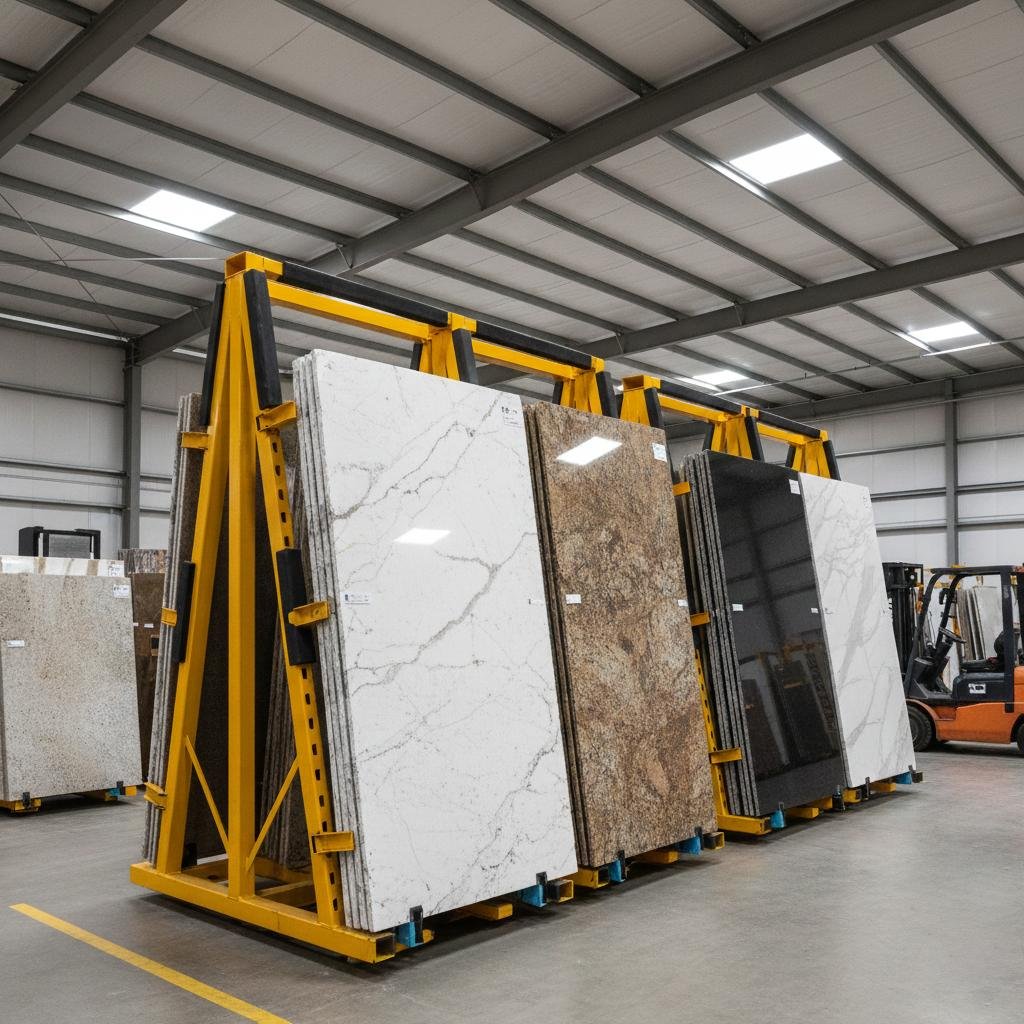
Granite slabs are heavy and vulnerable to damage if handled or transported incorrectly.
Appropriate packaging and logistics are therefore essential.
Insert Image 5 – Granite slabs secured for transport.
Important export considerations
Protective packaging: Slabs should be secured using suitable transport frames, supports and protective materials.
Proper handling: Suitable lifting equipment and trained personnel are required to move heavy stone slabs safely.
Container loading: Weight distribution, restraint systems and container payload limits must be considered.
Documentation: Buyers should confirm the required commercial invoice, packing list and other shipping or customs documents.
Product specifications: A purchase agreement should clearly state stone varieties, dimensions, thicknesses, finish requirements and accepted tolerances.
Vishwas Export provides packaging information for its porcelain slab and tile products. Granite-specific packaging methods and capacities should be confirmed separately with the company.
Why Choose Vishwas Export for Natural Stone Enquiries?
Based in Morbi, Gujarat, Vishwas Export presents a portfolio of tile and natural stone designs for buyers exploring surface materials.
The company’s website features granite varieties alongside ceramic and porcelain surface products.
For architects, distributors and buyers considering natural stone, reviewing the available product collection can be a useful first step.
Visit the Vishwas Export collection to explore surface designs or contact the Vishwas Export team to discuss your requirements.
Product sizes, stone varieties, finishes, stock availability and order terms should be confirmed directly before placing an order.
Frequently Asked Questions About Granite Slabs
What is the standard size of a granite slab?
There is no single universal standard size. Granite slabs vary according to the stone block, quarry and processing facility. Commonly encountered dimensions include approximately 2400 × 1200 mm and 2800 × 1600 mm, although actual availability differs.
What thickness is best for granite countertops?
Both 20 mm and 30 mm granite are used for countertops. The correct thickness depends on slab properties, fabrication, support requirements and installation design.
Which granite finish is best?
Polished granite offers a glossy appearance, honed granite provides a matte finish, and leathered granite has a distinctive texture. The best option depends on the intended application and maintenance preferences.
Are granite slabs suitable for outdoor applications?
Some granite varieties and finishes are suitable for outdoor use. Climate, slip resistance, installation requirements and the specific stone’s characteristics should be evaluated.
Can granite slabs be used for wall cladding?
Yes. Granite is used for both interior and selected exterior wall cladding applications. Proper fixing systems and structural design are essential.
What should international buyers check before purchasing granite slabs?
Buyers should confirm stone quality, dimensions, thickness, finishes, consistency, packaging specifications, shipping terms and relevant documentation.
Conclusion
Granite slabs offer natural beauty, durability and versatility for a wide variety of architectural and interior design projects.
Understanding granite slab sizes, thickness options, finishes and applications can help homeowners, architects, fabricators and commercial buyers make more informed purchasing decisions.
For international buyers, additional attention should be given to product consistency, handling, packaging and shipping requirements.
Choosing suitable materials and communicating clear specifications are essential steps toward a successful project.
Explore Natural Stone Products at Vishwas Export
Looking for granite and other surface products for your next project?
Explore the Vishwas Export product collections and discuss your requirements with the team.